


The mountain wind in Sukapura arrives gently, yet it chills straight to the bone. On these slopes where life is sustained by the soil, morning and evening are rarely ever truly separated from labor. There are farmers walking down to the gardens, seedlings being transplanted, land being cleared, vegetable crops waiting to be harvested, and young trees beginning to find their place amidst age-old farming habits. In a village like this, the forest is not something distant. It is present in daily conversations, along the walking paths, within the gardens, inside sources of livelihood, and in anxieties about the future.
For mountain communities, the land is the closest source of life. They do not fish, for the sea is far beyond their reach; instead, they sustain themselves on fields, gardens, and forests. Yet, it is precisely at this intersection that the dilemma grows complicated. How can the community continue to make a living from the forest without causing the forest to lose its vital functions? How can farmers secure an income without repeatedly reverting to cropping patterns that leave the slopes increasingly vulnerable? How can a slogan like “sustainable forests, prosperous communities” be kept from stopping short as nothing more than beautiful words on banners and documents?
These questions are a living part of the daily life of Mr. Dinar Santika, the Chairman of the Social Forestry Group (KPS) of Sukapura Village. He is trusted by the village head and the community to lead the KPS, which oversees 10 Social Forestry Business Units (KUPS). His role is not merely administrative. In the field, he must provide direction, mentor the KUPS chairmen, speak directly with the farmers, and gradually guide the community to understand that protecting the forest does not mean halting their livelihoods. On the contrary, for Dinar, the most critical challenge is finding a means of livelihood that keeps the forest standing.
“Sustainable Forests, Prosperous Communities. But That Slogan Must Become Reality.”
Dinar speaks those words not as jargon, but like someone who knows full well the heavy burden of translating program language into the reality of residents’ lives. On paper, the concept of social forestry often looks immaculate: communities are granted management access, groups are formed, work plans are drawn up, and the forest is protected collectively. Yet in the field, change does not move as quickly as a document.
“It is quite a heavy task to reshape the mindset of mountain people whose livelihoods stem from the forest, so that they do not destroy nature in the process,” Dinar said.
In Sukapura, some members of the community respond with an attitude he describes using the Sundanese phrase: sok ngalawan ku punduk. Simply put, he explains it as a gesture of nodding, as if in agreement, yet not necessarily fully understanding. They appear to accept the direction, but true awareness has not quite grown from within. There is a disconnect between the “yes” spoken in the meeting room and the actual change of habits in the garden.
That gap is precisely what they have been trying to bridge. Through village assemblies, socialization, consolidation, mentoring, and even direct reminders in the field, the KPS strives to build a new understanding. It is not just about the rules, but about why those rules matter. Dinar knows that change cannot be achieved merely through orders. Farmers must see the reasons, the examples, and the benefits. They have to believe that this new path will not cost them their very source of life.
From Vegetables to Woody Perennial Crops
One of the most difficult challenges is changing farming habits. For a long time, the community has been accustomed to growing vegetables. Vegetable crops yield faster returns, fit seamlessly into daily work routines, and connect directly to the family’s immediate financial needs. On the other hand, agroforestry demands patience. Planting coffee, timber, shade trees, or other perennials does not always provide an instant harvest.
Dinar emphasizes that this shift is not merely a change in land use, but a transition of lifelong habits. The word “habit” is crucial here, because what is being altered is not just the type of crop, but also the way people perceive time, risk, and benefit. Vegetables follow a short-term logic. Agroforestry, however, asks the community to look further ahead: toward more resilient soil, safer slopes, a forest restored to its function, and an economy that no longer relies on a single type of crop.
In activities joined alongside facilitators and academics, Dinar found a new language to explain practices that were, in fact, already largely known to their ancestors. He only recently realized that what used to be called mixed gardens, heritage gardens, or perennials can now be understood as talun gardens or agroforestry. For him, the concept is not merely a technical term. Within it lies a philosophy: humans can live off the garden without exhausting the garden itself.
He remembers his childhood and the stories of the elders. Long ago, the forest was cleared, but it was never left empty or filled with only a single commodity. There was taro, cassava, timber trees, plants you could eat, and plants that held the soil together. People lived off the garden, even when money was not yet the center of exchange. Times have changed now; the need for cash is greater. Yet that memory of diverse gardens still offers a guide: prosperity and sustainability do not have to be mutually exclusive.
Seedlings as a Language Understood in the Field
For Dinar, theory is important, but the community believes fastest when they see something tangible. Because of this, seedlings carry a much deeper meaning than just material assistance. Seedlings are a language that farmers easily understand. A seedling can be held, carried to the garden, planted, and watched as it grows.
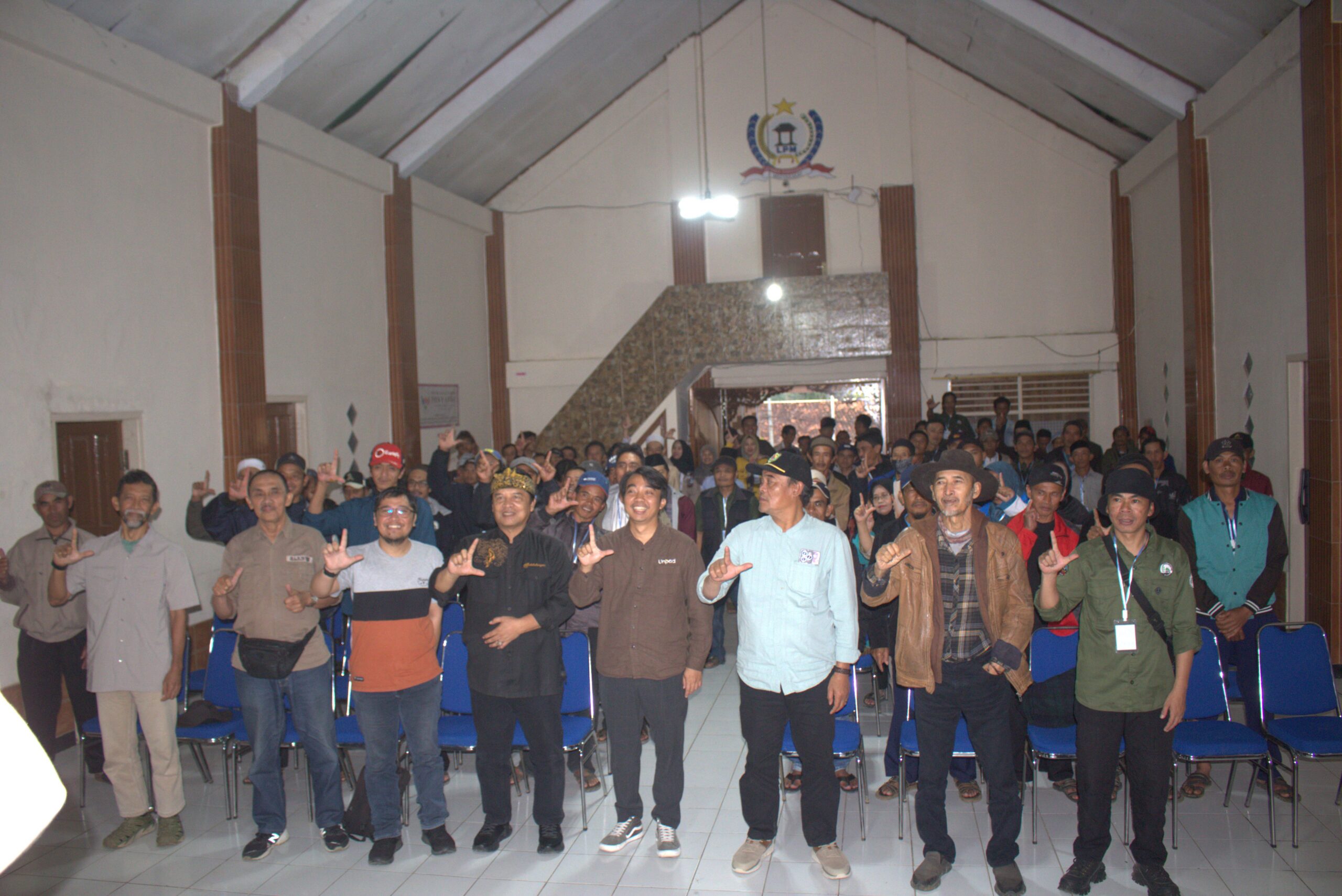
When environmental awareness and agroforestry activities began, the community’s enthusiasm was clear from the turnout. An invitation originally intended for about 80 people was instead attended by more than 100. For Dinar, that number is not just a participation statistic; it is a sign that curiosity is beginning to take root. The community came to see, to listen, and to understand the direction being set.
Yet, the measure of change he trusts most remains out in the field. When coffee seedlings were made available and announced for forest reforestation, the community came to collect and plant them. Dinar mentioned that within about a week, tens of thousands of seedlings from various sources began moving into the hands of the residents. Some came from the village government, agencies, farmer groups, aspiration networks, and support from other parties. What used to often require delivery directly to their homes or gardens, the community has now begun to pick up on their own.
For Dinar, this small change means everything. After years of pushing for reforestation, the enthusiasm for planting is a sign that awareness is no longer just coming from the outside. The community is beginning to accept that coffee and woody perennial crops can be a new path forward: protecting the hillsides while simultaneously opening up economic opportunities.
Talun Gardens as a Memory Given a New Name
One of the defining moments for Dinar was when he participated in an activity that brought together field experience and academic explanations. He listened to the speakers explain talun gardens, agroforestry, fruiting patterns, shade plants, woody perennials, terracing, and the relationships between trees, soil, roots, trunks, leaves, and carbon. Some of the terms felt brand new, but the substance of it was not entirely foreign.
“Oh, so this is what they call a kebun talun,” was roughly the realization that dawned on him.
That sentence is simple, but deeply important in the process of knowledge management. Many local practices actually possess an existing knowledge base, they just haven’t always been given a language that can be read within the framework of programs, policies, or science. When the term “agroforestry” meets the memory of mixed gardens, a bridge is built between academic and local knowledge. Dinar did not feel that field practice was being overshadowed by theory; instead, he saw that theory helped give a name to something that had already long lived within the community’s memory.
At this point, the program becomes a vehicle. It does not replace the farmers’ experience, but rather helps connect that experience with broader concepts: FOLU (Forestry and Other Land Use), carbon, food security, social forestry, and the restoration of ecological functions. Dinar realizes that protecting nature cannot be discussed merely as a moral obligation. It must be linked with “protecting the stomach”—with economic needs, group work plans, and the tangible proof that the crops planted today will provide benefits in the future.
A Slow, But Vital Shift
Dinar does not close his eyes to the challenges. He notes that the hardest work of all is changing the mindset—more precisely, altering human psychology. For years, farmers have shaped their habits based on daily needs, economic pressures, and inherited experiences. It is no easy task to ask them to shift toward a pattern where the results are not always immediate.
He uses the Sundanese expression alon-alon asal kelakon: slow but steady, as long as it gets done. This expression is not a justification for being slow, but rather an awareness that social transformation cannot be forced in a single planting season. It requires guidelines, personal approaches, tangible examples, patience, and prayer.
However, his critical notes are also clear. The community’s enthusiasm for planting remains heavily dependent on the availability of seedlings and guidance. While social forestry work plans demand progress, support from higher levels is not always felt to be swift or certain. Dinar points out that while groups are pressured to show results, seedling assistance, program confirmations, and material support do not always arrive in line with field demands. In the logic of the mountain communities, what is needed most is sometimes simple: pok, pek, cing prakna—less talk, let’s just get to work.
This criticism is not a rejection of the program. On the contrary, it is a plea for the program to be more down-to-earth. If the forest is expected to turn green, then seedlings must be available. If the community is asked to change, then guidance must be continuous. If groups are required to draw up annual work plans, then their capacity and resources must be strengthened. Ecological change cannot be burdened solely onto the enthusiasm of the residents while the supporting instruments remain inconsistent.
Caring for the Forest, No More Empty Talk
Toward the end of the interview, Dinar expressed a firm hope. He hopes that anyone with authority—from the village level up to the central government—will actively think of ways to restore the forest’s ecological functions. He isn’t just asking for material aid, though he acknowledges that seedlings remain desperately needed. He also stresses the critical importance of scientific guidance, direction, and the kind of support that assures the community they are on the right path.
“Please don’t grow weary of guiding us all, so we can keep fighting together to restore nature,” was his message.
For him, nature is already aging. Planting is a form of responsibility that cannot wait for perfect conditions. There is a firm belief that even if the rewards are not immediately reaped today, planting must still be done. However, he also asks that concern for the forest does not end as just omon-omon—empty talk that the community is tired of hearing. Caring for the leuweung (forest) must be translated into real seedlings, law enforcement, consistent guidance, market access, and true solidarity with the farmers who live around the forest.
From Sukapura, that message moves far beyond a single village. Agroforestry transformation is not just a matter of replacing vegetables with coffee, or adding trees to the slopes. It is a process of reorganizing the relationship between humans, land, forests, and the economy. It asks the community to change their habits, but it also demands that the state and its partners move past mere rhetoric. It requires awareness from below and genuine support from above.
In the hands of people like Dinar, the kebun talun is not an exercise in nostalgia. It is a way of reading the future: a future where the forest functions once more, the farmers sustain their livelihoods, and the village children inherit slopes that don’t just produce, but also protect. From the coffee seedlings now taking root in the soil of Sukapura, that hope is beginning to be planted—slowly, alon-alon asal kelakon, but bound to keep growing until the leuweung becomes, once again, a fair and just home for both humanity and nature.