


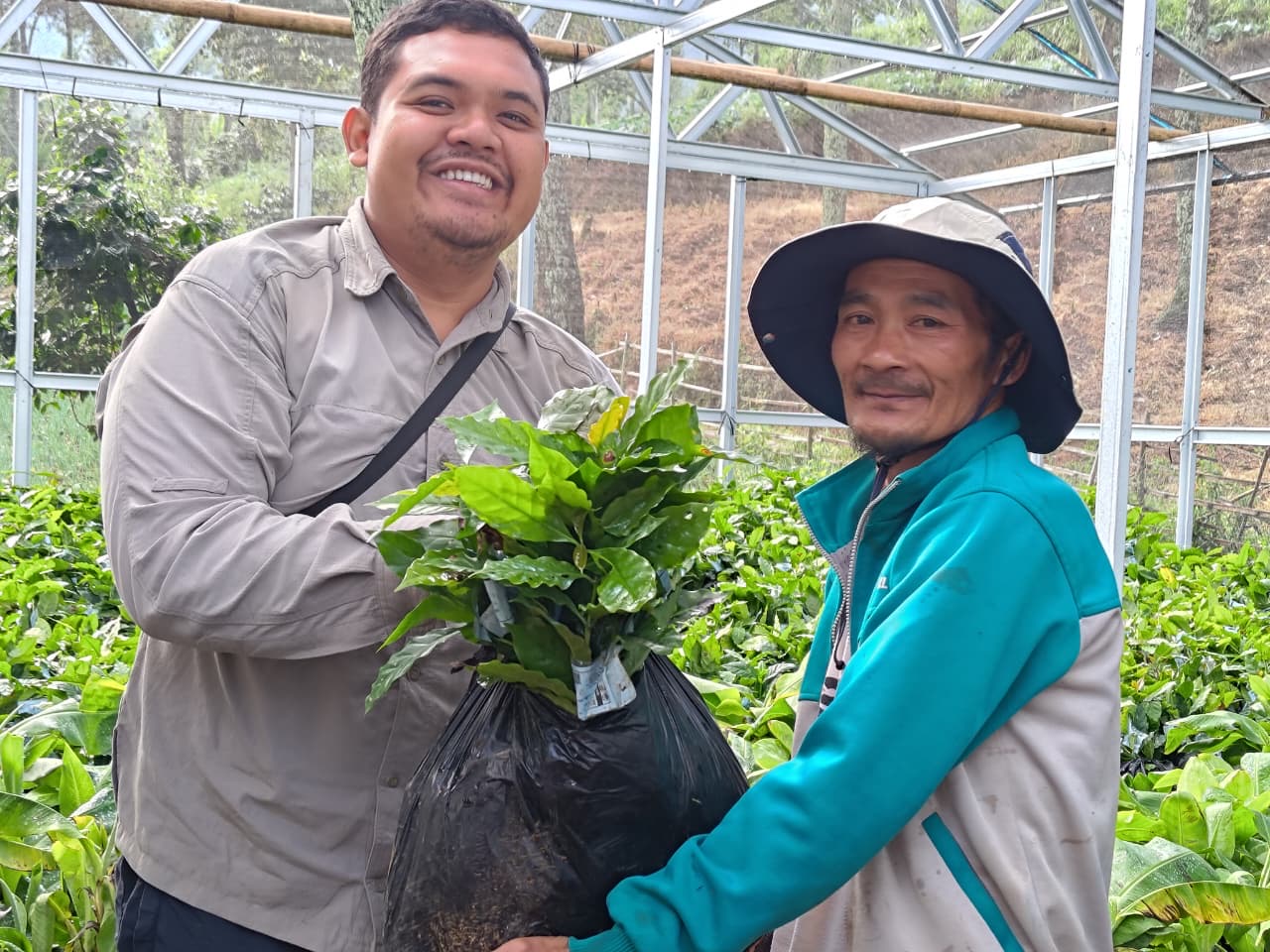
In the Kertasari highlands, the landscape is never completely still. Mist drifts over the fields, village roads follow the contours of the slopes, and the land holds layers of stories, not all of which are written. On one side, people see vegetables, coffee, small paths, settlements, and plots of land cultivated from season to season. On the other, there is a longer history: the headwaters of the Citarum, traces of old settlements, forest clearings, colonial plantations, and memories of how the Sundanese people survived through mixed gardens.
In the midst of such a landscape, discussions about agroforestry cannot simply begin with technical terms. It must return to an older language, a language that once lived in the daily practices of the Sundanese people: talun. Today, the word often survives only as a place name. Many villages are named Talun, but not everyone still knows what talun means as a gardening system. The name endures, but its practice and meaning are slowly fading.
For Yudi Hamzah, a historical practitioner and researcher, talun is not just a beautiful local term to be revived. Talun is a doorway to reading the long relationship between humans, land, trees, food, water, and family economy. From conversations with him, the talun garden emerges not as a romantic nostalgia, but as local knowledge that once worked: providing food, generating savings, maintaining crop diversity, and preventing humans from completely severing their connection to the land.
The Remaining Name, The Near-Lost Meaning
“Today, talun mostly exists as a place toponym,” Yudi said. In Rancaekek there is Talun, in Sumedang there is Talun, and in many Sundanese regions, the name repeats itself. However, the repetition of a name does not automatically mean the repetition of knowledge. Many people know Talun as a village name, not as a gardening system.
Yudi menelusuri kata itu melalui kamus bahasa Sunda dan naskah-naskah lama. Menurutnya, talun berasal dari bahasa Sunda kuno, merujuk pada kebun yang diisi pohon-pohon berusia panjang. Bukan tanaman sekali panen, melainkan tanaman yang memberi hasil berulang: mangga, kopi, alpukat, nangka, dan buah-buahan lain. Di bawah dan di antaranya, tumbuh tanaman musiman seperti bayam, kangkung, selada, kacang-kacangan, roay atau kacang koro, serta tanaman kecil lain.
Within that structure, the talun recognizes no single crop as the sole ruler. It is a mixed garden. Large trees provide shade, fruit crops yield seasonal harvests, short-term food crops meet daily needs, and the entire composition forms an uninterrupted rhythm of harvesting. Through this method of planting, people do not merely chase a single commodity, but weave together a way of life.
That is the fundamental difference between talun and monoculture. Talun does not only answer the question “what sells well,” but also “what allows a family to survive.” It does not separate economy from ecology. It does not separate daily food from long-term savings. Within it, the garden becomes a space that works across multiple timelines simultaneously: today, next season, and the years to come.
Kertasari in the Long Memory of Priangan
Yudi places Kertasari within a history of the Priangan landscape that is far older than modern land clearing. He points to the journey of Bujangga Manik, a prince from the Sunda Kingdom, who according to ancient manuscripts visited the upper reaches of the Citarum. Through this lens, Kertasari is read not as an empty space recently discovered by development programs, but as a region long known, inhabited, and imbued with meaning.
According to Yudi, this area was already known around the 14th or 15th century. However, massive land clearing occurred much later, particularly from the 19th century onward, when the forced cultivation system expanded landscape transformation. Forests were cleared, lands were opened, and crops with colonial economic value—such as coffee, tea, cinchona, and indigo—were introduced as primary commodities. In old maps, names like Kertasari, Maruyung, Pacet, and Cihawuk had already appeared, serving as signs that this region possesses a long history of settlement and land management.
At this point, the talun garden must be read carefully. It is not merely a local system that stands outside of major history. Rather, it lived, changed, and was pressured by political-economic shifts. When the Preanger Stelsel and later the Cultuurstelsel enforced the compulsory cultivation of specific commodities, mixed garden patterns were pushed aside. The people followed orders through traditional power structures. Forests that were once wild jungles slowly transformed into production lands geared toward the needs of the colonial market.
Those changes brought economic benefits to certain parties, but left behind lingering ecological questions. What is lost when a mixed garden turns into a monoculture? What happens when the soil is no longer given a respite? What are the consequences when crop diversity is replaced by a single dominant commodity?
When Mixed Gardens Become Monocultures
Yudi points to ecological damage as the heaviest risk. Economic losses can perhaps be calculated, but ecological losses often manifest in ways that are much harder to redeem: landslides, flash floods, the loss of soil carrying capacity, and the weakening of the landscape’s function as a water buffer. In a region like Kertasari, which lies within an upstream landscape and holds a crucial relationship with water management, changes in planting patterns are no small matter.
Monoculture changes the logic of the garden. The soil is constantly used, crops are continuously replaced, pauses vanish, and diversity narrows. In the traditional system, according to Yudi, there are stages. People open a garden, plant bamboo or large trees, give the soil time, cultivate it again, and then plant other varieties. There is continuity between one harvest and the next. There is room for the soil to rest. There is a connection between the practice of farming and reading the seasons.
One of the local wisdoms mentioned by Yudi is the ability to read signs of nature, such as the Orion constellation (Waluku). In old farming traditions, the appearance or disappearance of celestial signs could serve as a guide to the onset of a specific season. From there, people knew when to start tilling the soil, when to plant, when to weed, and when to let the land rest. This kind of knowledge was passed down orally, from parent to child, from child to grandchild, while being practiced in the garden.
The problem is, as monoculture systems grow stronger, knowledge that depends on oral tradition and practice weakens along with them. It is not always written down in archives. It lives in the bodies of the elders, in customs, in place names, and in terms that now often sound foreign to the new generation: reuma, tipar, talun. When the practice vanishes, those words turn into mere village names.
“Let’s Bring It Back First, Make It Exist First”
The most important quote from Yudi emerges when he speaks about preservation. “What are we trying to preserve if what is to be preserved no longer exists,” he said. “Let’s bring it back first, make it exist first, and introduce it once again.”
That sentence carries a deeply fundamental critique. All too often, conservation is discussed as if the object itself were still intact. Yet, in the case of the talun garden, what remains may only be names, fragments of practices, or unassembled memories. Therefore, the first step is not to immediately “preserve,” but to reintroduce. To show its form. To create demonstration plots. To explain its plant varieties. To revive its ecological logic. To connect it with the economic needs of today.
For Yudi, the talun garden cannot be revived by a single individual or just one small group. It requires a collective effort: political policy, academic support, assistance from civil society organizations, plant research, market research, historical research, and cultural research. In other words, talun needs to be brought to life as a knowledge ecosystem, not merely a planting package.
This is where agroforestry and FOLU (Forestry and Other Land Use) programs can position themselves as bridges—not as the inventors of talun, because talun is far older than the language of developmental programming, and not as heroes either, since its foundational knowledge springs directly from the community and local history. A more fitting role is to help pave a way home for this ancient wisdom: documenting, practicing, adapting, and reconnecting it with today’s ecological and economic needs.
A Cultural Heritage That Must Be Made Visible Again
The greatest challenge for the talun garden today is a visual and practical disconnection. Many people do not know what a talun actually looks like. What plants must be present? How is the canopy layer structured? What is the minimum required area? How do you combine perennial trees, fruit crops, food crops, and seasonal plants? How do you keep it profitable without degrading the soil?
Yudi reminds us that even the Sundanese people themselves do not necessarily recognize the differences between reuma, tipar, and talun anymore. If these terms are to be reintroduced, then demonstration plots become essential. People need to see, not just hear. Young people need to be brought into the gardens, not just read terms in seminars. Farmers need to be convinced through results, not merely through the romanticism of the past.
However, reviving talun does not mean completely copying the past. Yudi emphasizes the need for modifications in accordance with current conditions. The economic needs of families today are different from the barter era. Market access has changed. Commodities have changed. The climate has changed. Land pressure has changed. Therefore, modern talun gardens need to adapt: coffee can become one of the main crops, avocados or other fruits can serve as medium-term savings, local food crops can maintain family food security, and timber trees or bamboo can reinforce ecological functions.
In that way, talun is not a museum. It becomes a living, adapting system.
From Place Names into Future Directions
The story of talun in Kertasari is not merely a historical tale. It is a way of looking at the future of the upstream landscape. If the highlands play a vital role as a water catchment and buffer zone, then the cropping patterns there cannot be judged solely by short-term market yields. They must be viewed through the soil’s capacity to retain water, the roots’ ability to secure the slopes, the trees’ gift of shade, and the garden’s capacity to provide a living space for families.
Yudi’s hope is simple, yet long-term: that talun is reintroduced. Once it is known, it is practiced. Only after it is practiced can it be preserved and strengthened. He envisions that, in the next 10 to 20 years, the upstream regions acting as water catchments can once again possess a mixed-garden system that is ecologically stronger while continuously yielding economic benefits.
The message for partners, the government, universities, and assistants becomes clear: do not merely treat agroforestry as a technical term, but connect it with local language that has deep roots. Do not just plant trees, but build an understanding of garden structure. Do not simply chase seedling counts, but consider composition, function, the market, and the vitality of local knowledge. Do not just document the past, but help the community make it visible once again in the form of a real garden.
In Kertasari, talun may have once faded into the mere name of a village—a name spoken without being fully understood anymore. Yet, that name is not dead. It still holds the path back home. From the remaining words, from the memories of the elders, from ancient manuscripts, and from the soil that has nourished many generations, the talun garden can once again be read as both a heritage and a promise for the future.
Because sometimes, the path toward modern agroforestry does not always begin with a new term. It can start with an old word having its dust brushed off, its meaning replanted, and then being allowed to grow alongside the trees that give life. On the slopes of Kertasari, the future of community forests may just be waiting to be called back by a name that was once so deeply familiar: talun.