


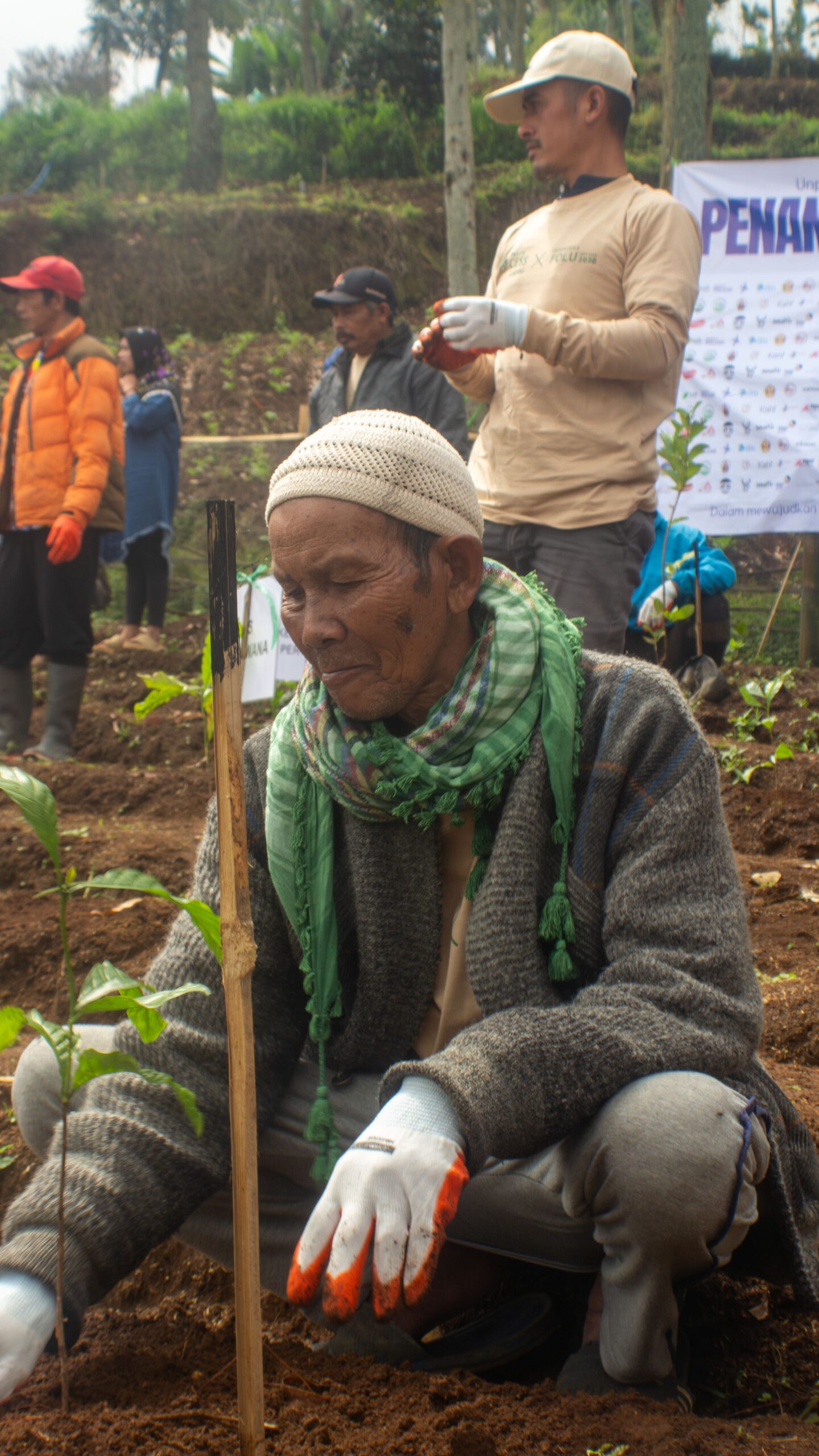
On the slopes of Cikembang Village, land is more than just a rhythm of life. Mornings begin with dew clinging to scallion leaves, afternoons are filled with brisk steps to the garden beds, and evenings conclude with calculations of fertilizer costs that often do not align with market prices. Here, vegetables such as potatoes, carrots, cabbage, chilies, and various types of onions seem the “most logical” choice: they are quick to harvest and quick to turn into cash. However, precisely because of that speed, the risks are more volatile, production costs are high, and the gradually thinning vegetation cover makes the slopes increasingly fragile.
At that point, agroforestry assistance based on cultural heritage—familiarly known as kebon talun—emerged not as a command to “completely replace” the villagers’ farming methods, but as an invitation to reorganize: combining short-term commodities with perennial plants that provide a long-term economic foundation while restoring the land’s protective functions. In the spirit of FOLU Net Sink 2030, through the FOLU Norway Contribution (NC) 2&3 program implemented by Universitas Padjadjaran, the voices of change are heard from Abah Diman, Chairman of KUPS LPHD Wanajaya, and Ibu Ai, a female farmer member who plants, calculates, and hopes in ways that often go unnoticed.
For years, vegetables were the answer. However, for Abah Diman, that answer began to feel multi-layered: there are profits, but there are also “ebbs and flows” that drain energy and capital. He saw how price fluctuations could turn months of hard work into uncertain calculations. From there, a new question arose: if vegetables are not always secure, what can serve as a buffer?
On the other hand, Ibu Ai describes a daily life that seems “fine” at the practical level: vegetables are planted as usual, and coffee is intercropped. “There are no problems at all,” she said at the beginning of her story—a sentence often uttered by farmers accustomed to withholding complaints. But when the conversation touched on matters larger than just planting—matters of access and capability—the root of the problem became clear: capital and seedlings.
“We don’t have the capital… if we want to plant, we have to buy coffee seedlings,” said Ibu Ai.
Figure 1. Abah Diman and Pak Acu (Chairman and member of KUPS LPHD Wanajaya) at the Cikembang Village Living Lab seedling house
When Seedlings Become the Entry Point
For Abah Diman, the biggest obstacle was not intent, but the “entry point” that was locked at the start: seedlings. The desire to transition to agroforestry land management could stall simply because of one seemingly simple thing: where are the seedlings?
“I used to be confused: where to look for seedlings… where to get coffee seedlings, I had to buy them,” said Abah Diman.
He mentioned that coffee planting programs had been heard of before, but the seedling distribution channels were unclear and access was unavailable. When seedlings must be purchased, the choice returns to a classic issue: there is the will, but capital is limited. In smallholder farmer households, this limitation is not just about “lacking money,” but is the reason why many plans stop before they even begin.
This is where the assistance unties the first knot: seedlings are provided, the path becomes clear, and residents can take action. Abah Diman emphasized that the seedling support, which he linked to Unpad’s role in providing assistance, finally broke the long-standing deadlock. Ibu Ai echoed this from a more grounded perspective: programs like this help small-scale residents who lack capital to “still be able to plant.”
In Cikembang, kebon talun is not a foreign term. It is an old method that actually holds a new logic: layered planting, organizing trees and catch crops, and keeping the soil “filled” with roots. The agroforestry assistance brings the same spirit but with a new emphasis: coffee and perennial plants as long-term economic buffers, while vegetables continue for immediate needs.
Ibu Ai mentioned that she still wants to plant potatoes. And therein lies an important lesson: the agroforestry accepted by the residents is not one that forces them to replace everything, but one that adds sensible options. For her, mixed planting is not a problem, as long as the land remains productive and the future is gradually prepared.
“If it’s mixed with those plants, it’s fine… eventually there will be more products,” said Ibu Ai.
The planting package she described illustrates the direction of diversification: coffee, then fruit/perennial plants such as oranges and guavas. “The new ones are guava… and orange. Those are new,” she said, while emphasizing that the distribution of other commodities, including rhizomes, is gradual. Behind the story of “just receiving this,” there is actually a major shift: the land is being organized for two needs simultaneously—today and several years into the future.
Figure 2. Ibu Ai and other female farmer members during the Technical Guidance on Cultural Heritage-Based Agroforestry.
The assistance does not stop at “the seedlings have arrived.” Abah Diman mentioned that there are training sessions and directions on planting methods—rules on spacing, organization, and maintenance. He described the process as practical knowledge that ensures residents do not plant “just to keep things alive,” but plant with a clear direction.
“Now there is training… there are rules on how to plant,” said Abah Diman.
Ibu Ai revealed that she is not always invited to or involved in the training sessions held. Consequently, the information she remembers most is about the “plants provided” rather than the actual rules or planting techniques. This indicates that assistance is not just about teaching technology, but also about who gains access to information, when, and through what channels.
Often, seedlings can be distributed neatly, but the information needed to care for and manage those plants does not always reach everyone. When knowledge is unevenly distributed, those left behind are not necessarily those who work the least, but often those who did not participate in the training, technical guidance, or assistance.
Planting Hope with Strong Roots
Abah Diman’s target sounds like a strategy: reducing dependence on volatile vegetables and strengthening long-term commodities through coffee within an agroforestry system. Ibu Ai’s target sounds like a hope: the program must continue, the assistance must not stop, and small-scale residents should have a chance to succeed. It is not just about planting, but also about having support so that the harvest can be absorbed by the market.
“Hopefully in the future, there will be someone to accommodate, someone to provide capital, and someone to buy the harvest,” said Ibu Ai.
Interestingly, that hope does not stop at economics. Ibu Ai linked the changes in the land to the story of the landscape: it was once a forest, then it was cleared and turned into vegetable plots because that was the quickest way to earn money. Now, as landslides and floods become more imminent threats, she hopes for plants with strong roots that can lock the soil and return the green to the slopes.
“I want the mountain to be green again… it’s good if there are plants with strong roots,” she said.
That sentence makes agroforestry feel like more than just a “cultivation package,” but rather an effort to restore the residents’ relationship with the mountain using simple yet effective language: strong roots, stable soil, and a safer life.
Figure 3. Members of LPHD Wanajaya participating in the Cultural Heritage-Based Agroforestry Assistance activity
Since the planting is still in its early stages, harvest results and income increases cannot yet be read as the “final outcome.” Abah Diman mentioned that this is still a work in progress and has not yet entered full maintenance. However, three initial changes are already clearly visible.
First, the bottleneck of seedlings and capital is beginning to clear. Abah Diman is no longer stalled by the confusion of searching for seedlings. Ibu Ai emphasized that the program helps smallholder farmers who previously could not afford to buy seedlings. Second, the long-term direction is becoming clearer: vegetables continue, but coffee and perennial plants are beginning to foster hopes for more stable income in the next 2–3 years, as fruit trees begin to produce and coffee plants grow strong. Third, ecological awareness is strengthening: the threat of landslides/floods has become an easily understood reason to plant perennials, not because of conservation jargon, but because of lived experience.
“This program is very helpful for the community… because we don’t have capital,” said Ibu Ai, concluding in the most honest way.
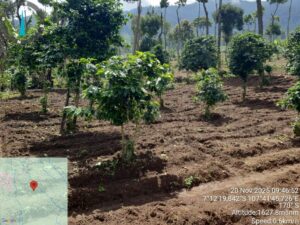
Figure 4. A plot of land belonging to one of the residents planted with coffee seedlings as part of the kebon talun reorganization.
The story of Cikembang serves as a reminder: major changes often begin with the most practical things—available seedlings, present assistance, and uninterrupted information channels. For today’s version of kebon talun to truly become an economic buffer and landscape guardian, support cannot stop at the planting momentum. Maintenance assistance needs to continue until the plants are stable, access to training must be ensured for all, including women, and equally important, downstream schemes (off-takers/buyers) need to be prepared so that residents are confident that planting today indeed has a place to sell tomorrow.
In Cikembang, Abah Diman and Ibu Ai have already begun that reorganization. What they need now is not just a new spirit, but sustainability: seedlings that survive, knowledge that reaches them, a real market, and a mountain that slowly turns green again—with roots that are strong and hopes that grow stronger alongside them.