


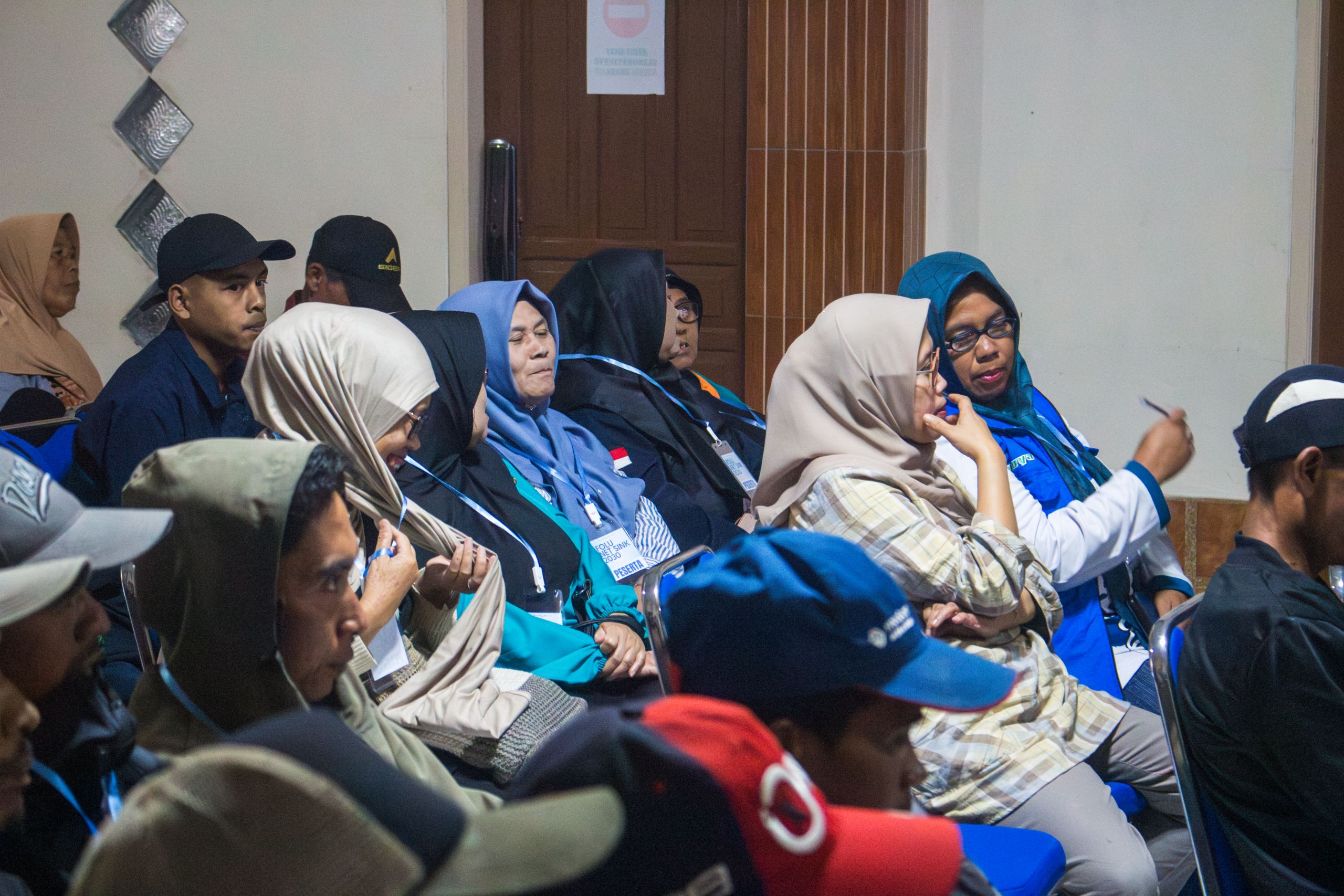
The afternoon in Sukapura felt like a brief pause before the rain. In the village yard, the women’s conversations flowed amidst soft laughter, Sundanese greetings, and memories of gardens that were never truly far from daily life. There were cassava, sweet potatoes, taro, corn, vegetables, coffee, home gardens, and small plots of land whose benefits were constantly sought. For many families in this village, land is not merely an empty space around the house. It is an additional kitchen, a small savings account, a place of learning, and a sign that village life still relies on what grows from the earth.
However, like many stories in agricultural villages, the effort to care for the land is not always balanced with the value returned to the residents. Crops exist, groups exist, local products exist, but the problems do not stop at the ability to plant. There are challenges in processing, selling, recording, marketing, maintaining group cohesion, and ensuring that knowledge does not only reach those who happen to attend a single meeting. It is in such a context that the Women Farmers Group (KWT) in Sukapura finds its role: not always large in terms of land size, but important in maintaining the connection between home gardens, family food security, the environment, and small household economies.
Amidst that conversation, Wulan Novianti, Head of the Sukapura Village PKK Mobilization Team, calmly introduced herself. Under the PKK, she explained, there are 10 programs divided into several working groups (Pokja). One of them is Pokja 3, where the Women Farmers Group or KWT is sheltered. In Sukapura Village, there are three KWTs: Sukamaju Waluya, chaired by Ibu Aat; Mekarsari Waluya, chaired by Ibu Erni; and Sukapadang Waluya, chaired by Ibu Lis Rohaeti. These names are not merely a list of organizations, but rather nodes of work for village women who manage many things simultaneously: gardens, food, posyandu (integrated health posts), household processing, and small local economic networks.
“Initially, we didn’t know what FOLU was.”
When she first heard FOLU, Wulan admitted she didn’t immediately understand what the term meant. For the KWT mothers, program terms often come from outside with language that is not always close to their daily lives. FOLU, agroforestry, greening, intercropping, land utilization—all these terms need to be translated into more concrete experiences: what to plant, where, how, and what benefits it brings to the family.
“Initially, we sometimes didn’t know what it was. What is FOLU? We didn’t know,” Wulan recalled.
But that lack of knowledge did not make them shy away. Instead, there was a sense of curiosity. They came, participated, listened, and then began to grasp that the discussion about FOLU was not solely about forests in a distant and grand sense. For them, the entry point was closer: greening, utilizing home gardens, planting methods, the benefits of plants for the environment, and how small spaces around the house could help improve life.
At this point, the program serves not as a final answer, but as a catalyst. It introduces a new language for practices that some residents already know. Before the activity, KWT and PKK already had activities. They had been planting, processing, collaborating with posyandu, and connecting garden produce with local food. However, after participating in the activity, there was an increase in knowledge: that what they were doing could also be understood as part of greening, land improvement, food security, and more directed agroforestry practices.
Gardens that are intended to be productive
For Wulan, the direction of KWT development after participating in the activity was quite clear: every household should be able to utilize its garden. Not just to look green, but also to produce something. At the very least, the produce can be consumed by the family itself. Furthermore, she hopes that gardens can help the family economy.
“Every house, the garden land can be utilized and can produce at least for the family itself,” she said. Beside her, Ibu Lis added with a simple sentence: “Increase income.”
In Sukapura, the food crops mentioned by the women are not foreign commodities: cassava, sweet potatoes, taro, and corn. These plants are part of the local kitchen, but also raw materials for the collective work of PKK and KWT. Garden produce does not always remain as raw material. Some are sold to stalls, some are processed, some go into Supplementary Feeding (PMT) activities for posyandu. In Pokja 3’s innovation, there is a spirit of “cultivating local food consumption,” which is then connected to the B2SA menu for infants, toddlers, and pregnant women.
This is where the story of Sukapura KWT becomes more than just a story of planting. A small chain is being built: from garden to kitchen, from kitchen to posyandu, from posyandu to family health, and from harvest to MSMEs. With Pokja 2, they are connected to local business units. Sukapura Village has several MSMEs, some operating in food processing. The products mentioned are diverse: cassava chips, sweet potato chips, sweet potato kremes, wajik (sticky rice cake), candied eggplant, candied carrots, candied papaya, and even potato chips.
At this level, technical changes do not always appear dramatic. There is no huge leap from zero to industry. What is seen is more subtle: the women begin to view their gardens as a source of food, products, and opportunities. They are not just planting to pass the time, but are starting to connect plants with family consumption, posyandu PMT, and small village businesses.
“It’s always the same people”
However, every change has unfinished parts. In Sukapura, the first challenge is not just about land or seeds, but cohesion. Erni, Chairwoman of KWT Mekarsari Waluya, stated this honestly. In one group there can be many names, but when processing work or KWT activities are underway, the people present are often the same.
“Cohesion is the most important thing,” she said. “When it comes to KWT processing itself, it’s always the same people. The others are just names.”
That statement is important because it shows that institutionalization cannot be sufficiently proven by structure alone. There are leaders, members, and groups, but collective work requires presence, role division, and a sense of ownership. For KWT, the challenge is not merely to create activities, but to ensure that these activities are not solely supported by a handful of the same individuals.
The second challenge is marketing. Erni mentioned limited IT skills as an obstacle. Products are already available. Activities are already running. But the market still largely revolves around Sukapura Village. Online sales have not developed. More modern marketing still feels distant, not because the women don’t have products, but because access, digital capabilities, and market assistance are not yet strong enough.
At this point, a critical note becomes clear: strengthening KWT cannot stop at planting training. KWT needs knowledge of post-harvest, processing, product design, simple record-keeping, digital marketing, and how to divide roles so that members are not just present on a name list. Without this, productive gardens risk remaining local activities with limited economic benefits.
Coffee, vegetables, and opportunities yet to be reached
When talking about KWT land, Wulan mentioned that currently, dominant crops are still vegetables. Perennial crops are not yet widespread. They once had coffee seedling activities through collaboration with the village government and related parties. Coffee is not a foreign plant to them. In Sukapura, there are already processed coffee products, including ground coffee from local MSMEs like Abajadun and Halawa. However, coffee products are still in a simple form.
When the conversation touched upon coffee skin or cherry, a new possibility emerged: cascara. Wulan admitted she didn’t know about it. When it was explained that dried coffee skin could be used as a beverage ingredient, her response was spontaneous and open: “We haven’t gotten there yet. Later, that will be the next step.”
That sentence reflects Sukapura’s current position. They are not stagnant. They already have materials, products, and local networks. But many value-added opportunities are still ahead, not yet fully explored. Cassava peels have even been utilized to make chips or crackers. Potato peels go into POC (liquid organic fertilizer) or biopore holes. Household waste is managed through a waste bank, Barakatajaga—used household items become valuable—as well as used cooking oil soap with ecoenzymes, although some are still given as gifts at events and not widely sold.
From this, it is clear that a mindset of utilization has grown. What is not yet mature is the business ecosystem: how products are standardized, packaged, given a story, costed, marketed, and connected to a wider range of buyers. Sukapura KWT does not lack activities. What they need is a way for these activities to level up without losing their local roots.
“The memory needs to be recharged”
The most powerful quote from Wulan emerged when she spoke about the hope for sustainability. She did not ask for programs to stop after a single activity. She used a simple, relatable, and humorous analogy: like a mobile phone, the mothers’ knowledge needs to be “recharged.”
“If it’s a phone, it gets charged. The mothers’ memory needs to be recharged,” she said, then explained the Sundanese term barho: bubaran poho, after dispersing, forgetting.
Behind that jest lies a serious message about the design of community assistance. One-time training often provides initial enthusiasm but is not always enough to change practices. Knowledge needs to be repeated, practiced, mentored, and linked to real needs. Especially for groups whose members have many domestic and social roles, learning does not always take place in formal classrooms. It happens while processing cassava, preparing PMT, managing posyandu, cleaning the yard, planting vegetables, or discussing after the rain.
Thus, barho is not just a joke. It is a local concept about the fragility of program memory if not maintained by ongoing processes. It reminds us that good assistance does not just come to deliver material, but returns to ensure that the material lives on in practice. In the context of Sukapura KWT, “recharging” means repeated training, direct practice, land arrangement, marketing, product processing, and mentoring until members are truly able to operate independently.
From small gardens to longer-term change
The hopes of the Sukapura KWT mothers are not extravagant. They want the land to be better organized. They want KWT to develop, progress, and its benefits to be felt by the community. They want every home to have useful plants. They want existing products not to stop within the village environment. They want knowledge about greening, agroforestry, and garden utilization not to disappear after the event ends.
For program partners, government, universities, facilitators, and buyers, the message from Sukapura is quite concrete. Subsequent assistance needs to move from awareness to more measurable practices. KWT needs help with land arrangement, strengthening local products, digital marketing training tailored to members’ abilities, simple record-keeping, developing coffee and non-coffee processed products, and strategies to ensure that passive members can also feel a sense of ownership. A good program does not stop at participants attending training, but at the group’s ability to maintain practices after the facilitators leave.
Sukapura shows that transformation sometimes begins with things that seem small: home gardens, cassava for PMT, chips from garden produce, simple ground coffee, used cooking oil soap, or the laughter of mothers when they mention barho. But it is from these small things that the foundation of change is often built. In the hands of the KWT mothers, small plots of land can become learning spaces. Local food can become a path to family resilience. Waste can become a product. Coffee can become a value-added opportunity. And knowledge, if continuously “recharged,” can grow into empowerment that lasts longer than a single training session.
From the small gardens of Sukapura, the future of community agroforestry is not only determined by land area, but by a collective memory that is continuously nurtured—so that after dispersing, they do not forget; and after learning, they can truly cultivate change from the land closest to home.