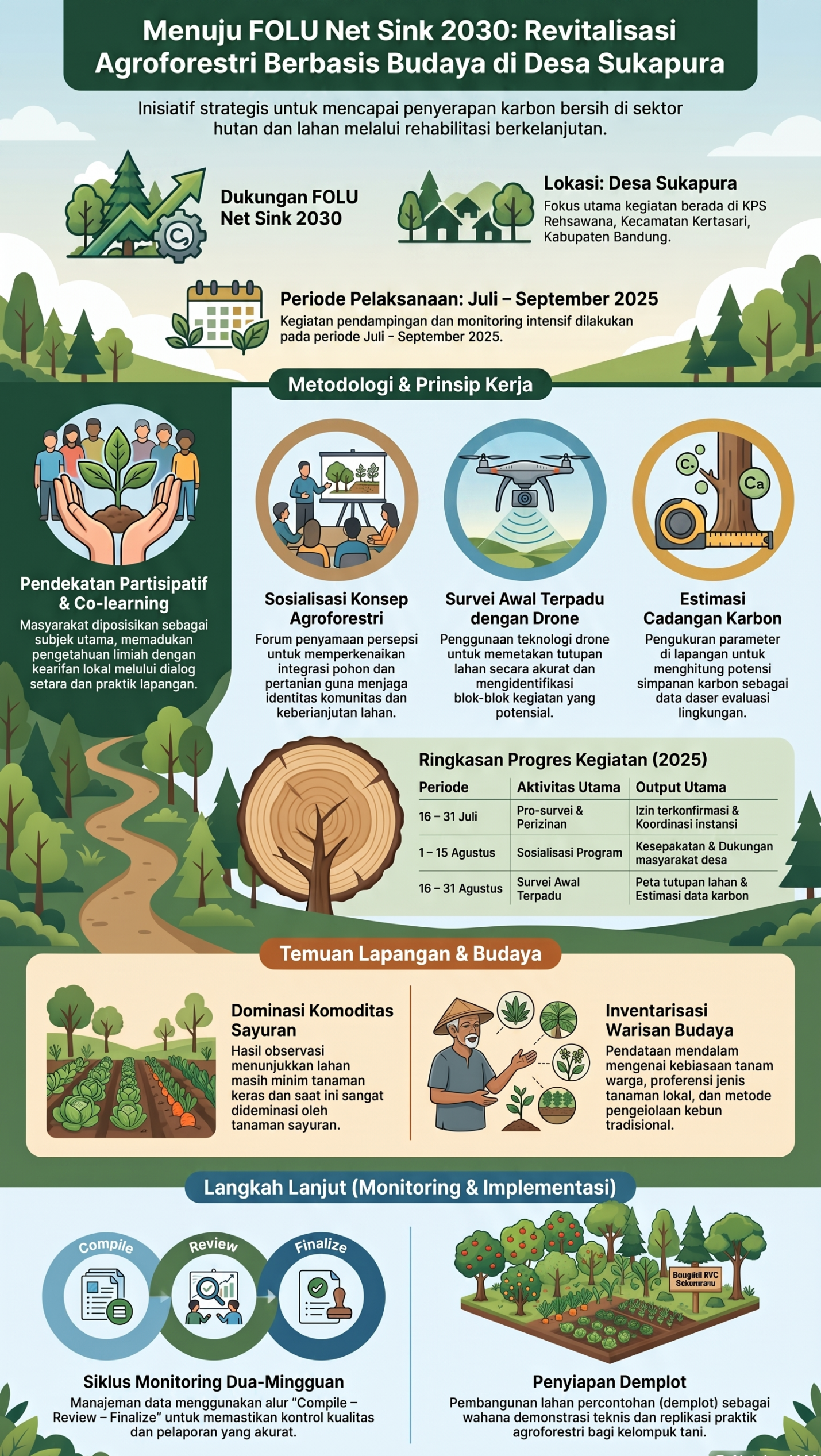
1. Strategic Vision: Toward Indonesia’s FOLU Net Sink 2030 The agroforestry revitalization program in Sukapura Village, Kertasari District, is a concrete step in supporting Indonesia’s national FOLU Net Sink 2030 target. This ambitious target positions the forestry and other land-use sector as a net carbon sink by 2030. In Sukapura Village, this strategy is implemented through strengthening forest and land governance based on local approaches and cultural heritage. The main focus is to create a balance between ecosystem recovery, carbon stock stability, and improved community economic welfare through adaptive and sustainable land management practices. By positioning the community as the primary actor, this program seeks to ensure that land rehabilitation efforts are not only technically effective but also firmly rooted in the local community’s social life.
2. Assistance Methodology: Participation and Co-Learning The success of the program in Sukapura Village rests on an inclusive and dynamic methodology. The approach used is participatory, positioning the community as the primary subject, while facilitators act as a bridge between scientific knowledge, government policy, and local wisdom. The principle of co-learning is the spirit of every interaction in the field. Through a repeating cycle—from concept presentation, hands-on practice, reflection, to design adjustment—local knowledge such as planting calendars and tree species preferences is combined with modern soil and water conservation techniques. Data collection was carried out comprehensively using Participatory Rural Appraisal (PRA) instruments to map the socio-cultural context, focus group discussions (FGDs), and direct field observation through transect techniques.
3. Timeline of Activities: Initiation and Socialization Phase (July–August 2025) Program implementation during the July to September 2025 period was divided into several important phases. In the initial phase (July 16–31, 2025), the team focused on aligning plans and ensuring legality through intensive coordination with the Kertasari District Government, Sukapura Village Government, and KPS Reksawana. This step was crucial for building legitimacy and shared understanding of the implementation schedule at the site level. Entering August, activities continued with program socialization to the community. This forum became a crucial space for aligning perceptions on the goals of agroforestry revitalization and its relationship to the FOLU Net Sink 2030 target. In this meeting, the community welcomed the program plan and expressed hope that physical implementation could soon be carried out to address the environmental challenges in their village.
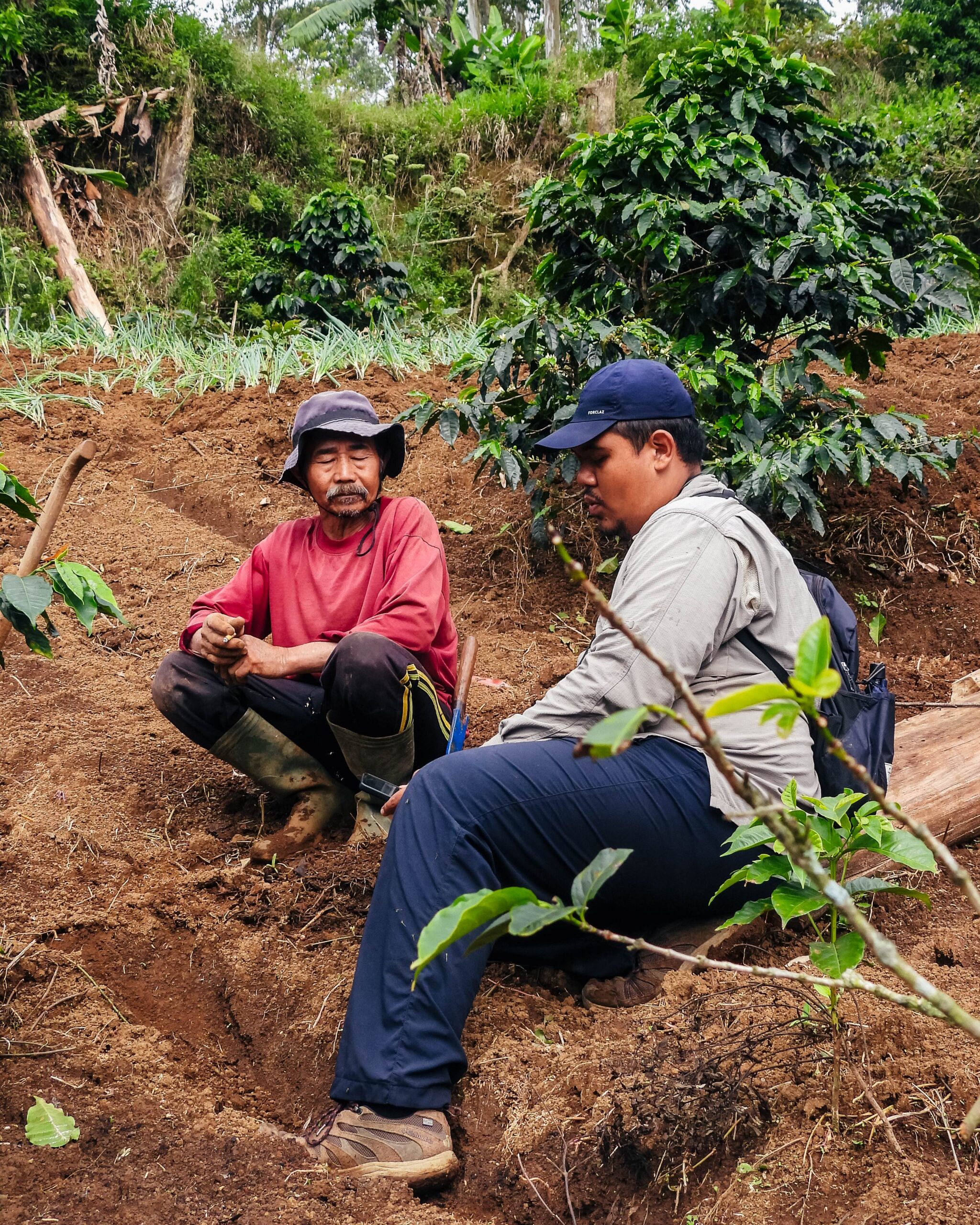
4. Integrated Initial Survey Results: Technology and Culture-Based Mapping One of the main technical achievements during this period was the implementation of an integrated initial survey conducted from mid to late August 2025. The team used drone technology to accurately map land cover and calculate estimated carbon stock in the planned activity area. In parallel, an inventory of cultural heritage practices was conducted through in-depth interviews on residents’ planting habits, use of traditional plants, and the institutional structure of local groups. This data was then compiled into a land cover map and a draft stakeholder list to serve as strategic partners in program implementation in the field.
5. Ecological Challenges and Site Condition Analysis Field observation results revealed a real challenge that must be faced: the planned activity area is currently minimally planted with perennial trees and heavily dominated by vegetable commodities. This dominance of monoculture vegetable farming indicates high economic dependence but also significant ecological risk, such as potential erosion and lower carbon absorption compared to a forest system. This finding underscores the urgency of transforming the land toward a more balanced multistrata agroforestry system. The community needs concrete examples to prove that planting perennial trees among crops will not harm their income, but rather provide long-term protection for the land and diversification of yields.
6. Adaptive Monitoring System: Ensuring Sustainability To ensure every activity stays on track, this program implements a strict data governance system through bi-weekly monitoring. This process follows the Compile–Review–Finalize cycle: facilitators compile daily data from the logbook, perform quality control on data consistency and photo documentation, and finally compile a progress summary report and follow-up plan. This adaptive management mechanism allows the team to quickly identify obstacles or community complaints in the field and make iterative strategy adjustments. This data transparency is an important asset for strengthening trust among stakeholders and ensuring that ecological and economic benefits can be sustainably felt by the residents of Sukapura.
7. Conclusion and Future Plans Overall, the July to September 2025 period has successfully established a solid foundation of coordination and socio-ecological baseline data in Sukapura Village. The social readiness of the KPS Reksawana community has been confirmed, and technical opportunities for transitioning to culture-based agroforestry are wide open. Future activities will focus on technical preparation of the demonstration plot (demplot) location as a means of demonstration and replication for other farmers. With synergy between modern technology (such as drone mapping) and inventoried local wisdom, Sukapura Village is ready to become a model of a sustainable village that makes a real contribution to global climate resilience through the FOLU Net Sink 2030 framework.